Wave height gets the dock-talk attention because it is easy to picture. Three feet sounds small. Eight feet sounds big. But the seconds beside the height can change the whole read. A short-period three feet can feel like local chop. A longer-period three feet can carry more organized energy and show up differently at a beach, harbor entrance, or point.
Period is the time between passing wave crests at the buoy. If a buoy says 4 feet at 8 seconds, the average spacing is tighter and usually more wind-driven. If it says 4 feet at 16 seconds, the waves are more spread out and often tied to energy that traveled farther. That does not make one safe and the other dangerous by itself. It means the height number needs context.
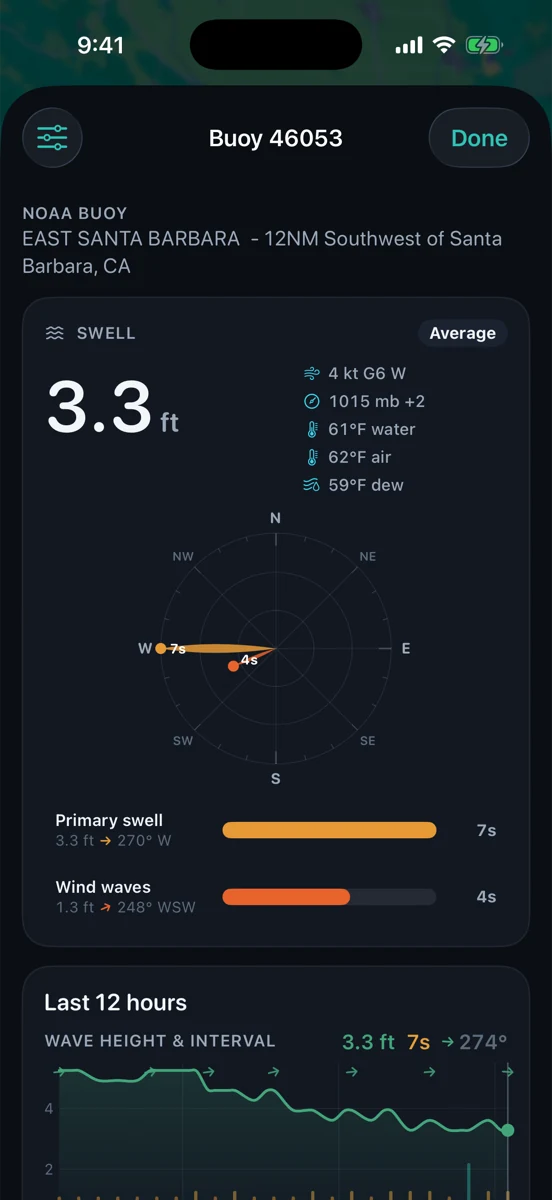
Short period: close, choppy, and often local
Short-period waves usually feel closer together. They can come from nearby wind, especially when the forecast wind has been blowing over the same water for a while. For small craft, anglers, paddlers, and surfers, that closeness matters. It can make the water feel busy even when the height number does not look dramatic.
A short-period read is not automatically bad. Sometimes it is just afternoon texture. Sometimes it is the warning that the smooth morning window is gone. The practical question is whether the period lines up with the wind, the local exposure, the tide stage, and what your spot usually does when the surface gets stacked up.
Longer period: more spacing, more reach
Longer-period swell has more time between crests. It often comes from weather farther away and can carry farther before it reaches the coast. Surfers tend to notice because longer-period swell can wrap, refract, and focus in ways that make a beach or point act bigger than the open-water height suggests.
Boaters and anglers should care too. A longer-period swell can be easy to underestimate offshore, then matter at bars, reefs, shoals, exposed anchorages, or entrances where depth and shape stand the energy up. Again, period is not a verdict. It is a clue that the height may travel with more push than the simple number implies.
Direction decides who feels it
Period does not act alone. Direction decides which stretches of coast are exposed, sheltered, or only partly lit up. A west swell and a south swell can show completely different faces to the same region. In Santa Barbara, the Channel Islands, points, and local bathymetry all get a vote before the number reaches the sand or harbor.
That is why the useful read is height plus period plus direction. The swell rose is good for this because it turns those pieces into a shape you can scan. It still does not promise surf quality or a smooth crossing. It just helps you stop reading a buoy as one magic number.
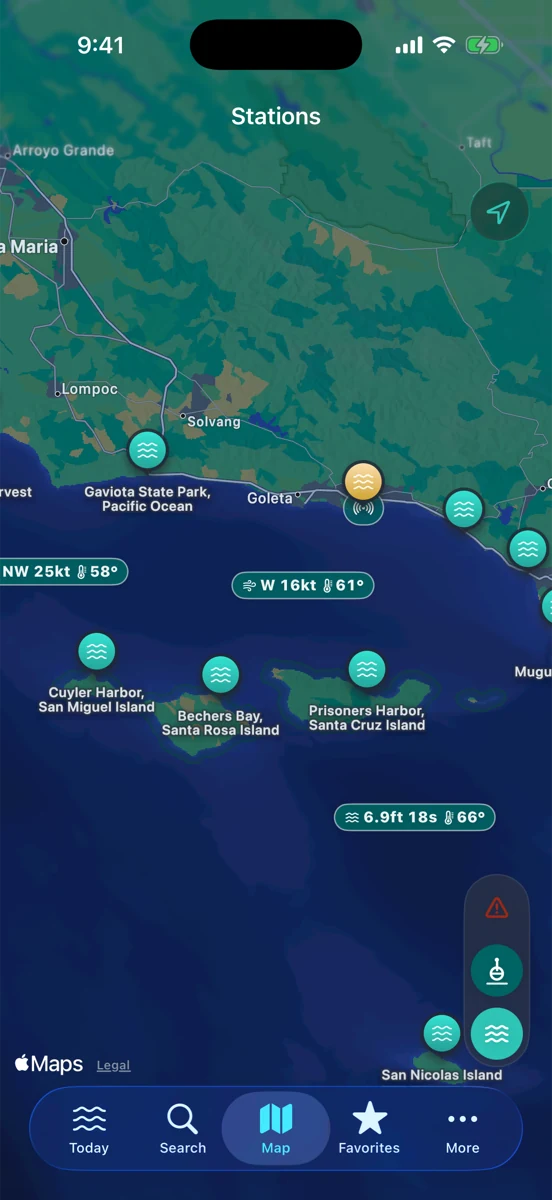
Tide can make the same swell feel different
The buoy tells you what the water is doing at the sensor. The tide curve tells you what the local depth and current may be doing at your spot. Those two reads belong together. A harbor entrance, reef, sandbar, or tide-pool shelf can change fast when a swell train meets moving water.
If you are checking Southern California water, start with the use case nearest the thing you are translating: the surf view, the fishing view, or the boating view. Station-specific tide pages are still in pilot review, so this post links to segment guides for now. Then read the buoy and forecast around that tide window. The goal is not a fake green light. The goal is fewer surprises.
A simple pre-check
First, read the latest NDBC observation: wave height, dominant or swell period, direction when available, wind, gusts, and timestamp. Second, compare it with the National Weather Service marine forecast for the broader window. Third, check the tide curve for the period you actually plan to be near the water. Fourth, ask what your coast does with that direction and period.
For surfers, that might mean whether the period and direction match the spot's exposure. For anglers, it might mean whether structure, current, and water temperature give the walk a reason. For boaters, it might mean whether an entrance or channel deserves a slower, more conservative plan. In every case, period is one clue in the stack.
Rip's rule: respect the seconds
Do not turn period into a superstition. Twelve seconds is not always good. Sixteen seconds is not always dangerous. Eight seconds is not always junk. The ocean is messier than that. But if the seconds jump, the direction lines up, and the forecast or tide stage adds pressure, pay attention.
Read the buoy, then read around it. The best pre-check is boring: height, period, direction, wind, tide, forecast, local shape, and your own eyes. Boring is good. Boring is how you save the energy for the actual water.
Read the buoy without guessing.
RipCat brings NDBC buoy observations, NOAA tide predictions, and NWS marine forecasts into one calm app for U.S. coastal waters. Use it as a planning aid, not navigation advice.
Get RipCat free on the App Store